

India has finally implemented the Four Labour Codes — first passed in 2019 and now replacing 29 separate labour laws. It marks one of the most significant shifts in India’s labour framework since 1947. This is a strategic economic reform aligned with India’s ambitions to become a global manufacturing and innovation hub.
Why This Matters NOW
The new codes — Wages, Industrial Relations, Social Security, and Occupational Safety & Working Conditions — aim to streamline compliance, enhance worker protection, and prepare India’s labour market for a gig-driven, digital-first future.
Old Regime vs New Codes: A First Glance
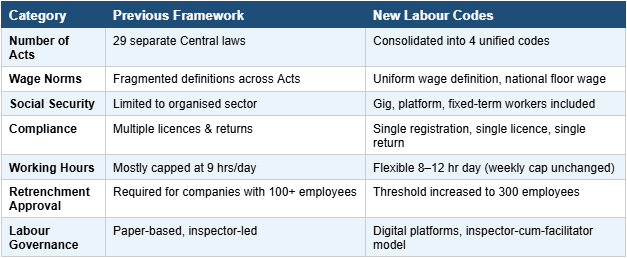
Without waiting for a tsunami of webinars, LinkedIn articles and workshops to follow in the coming weeks, I would argue that there are two ways of understanding the new framework — What will stay the same and What will change.
What Will Stay the Same
Fundamental worker protections will continue:
- Right to minimum wages
- Prohibition of child labour
- Maternity benefits for eligible women
- Gratuity entitlement for continuous service
- Provident Fund & Pension coverage for organized workers
- ESI protection for establishments and workers that meet earlier thresholds
- Equal remuneration for men and women
The concept of employer liability remains:
- Conditions of Safe working
- Timely payment of wages
- Maintaining registers/records
- Ensuring no discrimination or unfair labour practices
- Complying with working hour limits
Industrial Disputes Framework and the philosophy of maintaining industrial peace remains:
- The basic mechanism of dispute resolution continues
- Works committees, conciliation officers, tribunals still exist
- The definitions of “strike”, “lockout”, “lay-off”, “retrenchment” remain
- The need for notice of strikes/lockouts continues
Factory safety standards still apply:
- Occupational safety, ventilation, sanitation
- Safety committees
- Medical facilities in hazardous industries
- Working conditions for young persons
Working hour caps continue to protect worker fatigue:
- 48-hour weekly cap is unchanged
- Mandatory weekly off continues
- Overtime rules continue
Role of State Governments is crucial:
- States will frame rules under each Act
- Compliance varies state to state
- Record keeping and inspections will exist for oversight
Protection philosophy for Women workers remains:
- No discrimination in wages
- Safety and welfare provisions
- Maternity benefits
- Restrictions based on safety norms
Social Security contributions and obligations still required:
- EPF
- ESI
- Gratuity (funded by employer)
- Bonus provisions
Then Why Are These Reforms So Strategic?
These Labour Reforms Will Enable India's Next Growth Curve
Predictable and modern labour regulation is a key pillar of India’s journey toward a $5–10 trillion economy. Simplified codes reduce regulatory risk and strengthen India’s value proposition for global investors.
Harnessing the Demographic Dividend
Employment has grown from 47.5 crore in 2017-18 to 64.3 crore in 2023-24. The codes aim to push formalisation further so that India’s youthful workforce becomes a productivity engine, not merely a numbers advantage.
Bringing All Stakeholders Together
The codes are designed on a tripartite philosophy — labour, management and government. A digital platform for labour compliance enables transparency, portability of benefits, and reduced friction.
Boost to Manufacturing & Global Supply Chains
India’s ambition to lead in electronics, autos, textiles, pharmaceuticals and semiconductors require flexible labour systems. With longer shift options, national contractor licenses, and modern safety norms, the codes align India with global factory standards.
Administrative Simplification & Decriminalization
A long-standing ask of industry is now reality: reduced paperwork, rationalized inspections, and decriminalization of most compliance provisions — making “Ease of Doing Business” practical.
Expanded Social Security
For the first time, gig workers, platform workers and fixed-term employees are formally recognized. Social security becomes universal in intent, not sector-bound.
Balancing Worker Protection with Competitiveness
- Protection: minimum wage, appointment letters, equal pay, safety norms
- Competitiveness: flexible hours, higher retrenchment threshold, pan-India licenses
India is signaling that labour welfare and business growth will go hand in hand.
The Challenges: What We Cannot Ignore
MSMEs Stress
Large companies will adapt faster; for MSMEs — already operating below scale — transition could be complex and expensive in the short term.
Women's Participation in the Workforce and Organizational Bias
While the codes allow night shifts and mandate safety, they do not directly solve structural barriers that have led to declining female participation. It also does not directly address other minority groups of the workforce such as People with different abilities, LGBTQ+ etc. Ageism remains a bias at various levels in the organization.
State-level Variability
Implementation depends heavily on state rules. Without harmonization, India could see patchy, inconsistent enforcement.
Self-Regulation & Monitoring Gaps
The architecture for inspections and worker grievance mechanisms will need clarity and operational strength. The new role of Inspector cum facilitator can create ambiguity and role clarity issues would surface later if not addressed now.
Union Pushback
Resistance from trade unions could create friction unless communication, awareness and consultation continue at ground level. Ultimately, implementation will determine success — not the text of the codes.
What Needs to Happen Beyond the Implementation
- Local community engagement at district and block levels to register workers, raise awareness and build trust
- Skill building for future-ready sectors: EDSM (electronics design & manufacturing), pharma, auto, textiles, semiconductors
- MSME support through phased compliance, digital toolkits and training
- Digital infrastructure for labour platforms must be robust, inclusive and mobile first
- Women-centric programs to address return-to-work, safety, childcare, and flexible employment reforms
India has an opportunity to build a globally competitive and socially responsible workforce model — but only if execution matches the ambition.
Closing Thoughts
The Labour Codes are a reset of how India views work, workers, and workplaces of the future. They create a foundation for a flexible, digital, high-skill workforce ready for the next many decades. But as with all major reforms, the true test lies in execution — in factories, gig platforms, communities, MSME clusters, industrial parks, and district labour offices across the country. As Indians, we ought to get the implementation right, as this reform will be remembered as the moment when India modernized its workforce architecture.